Speaking the Language of Growth: The World’s Key Languages for Sales and Marketing
Global business has never been more accessible. A company can launch a website in Manchester today and potentially attract customers in Madrid, Dubai, São Paulo or Shanghai tomorrow.
But being visible internationally doesn’t necessarily mean you’re communicating effectively.
For businesses looking to grow across borders, translating and localising sales and marketing content into the world’s most commercially important languages can make the difference between simply entering a market and genuinely connecting with it.
Which Languages Matter Most?
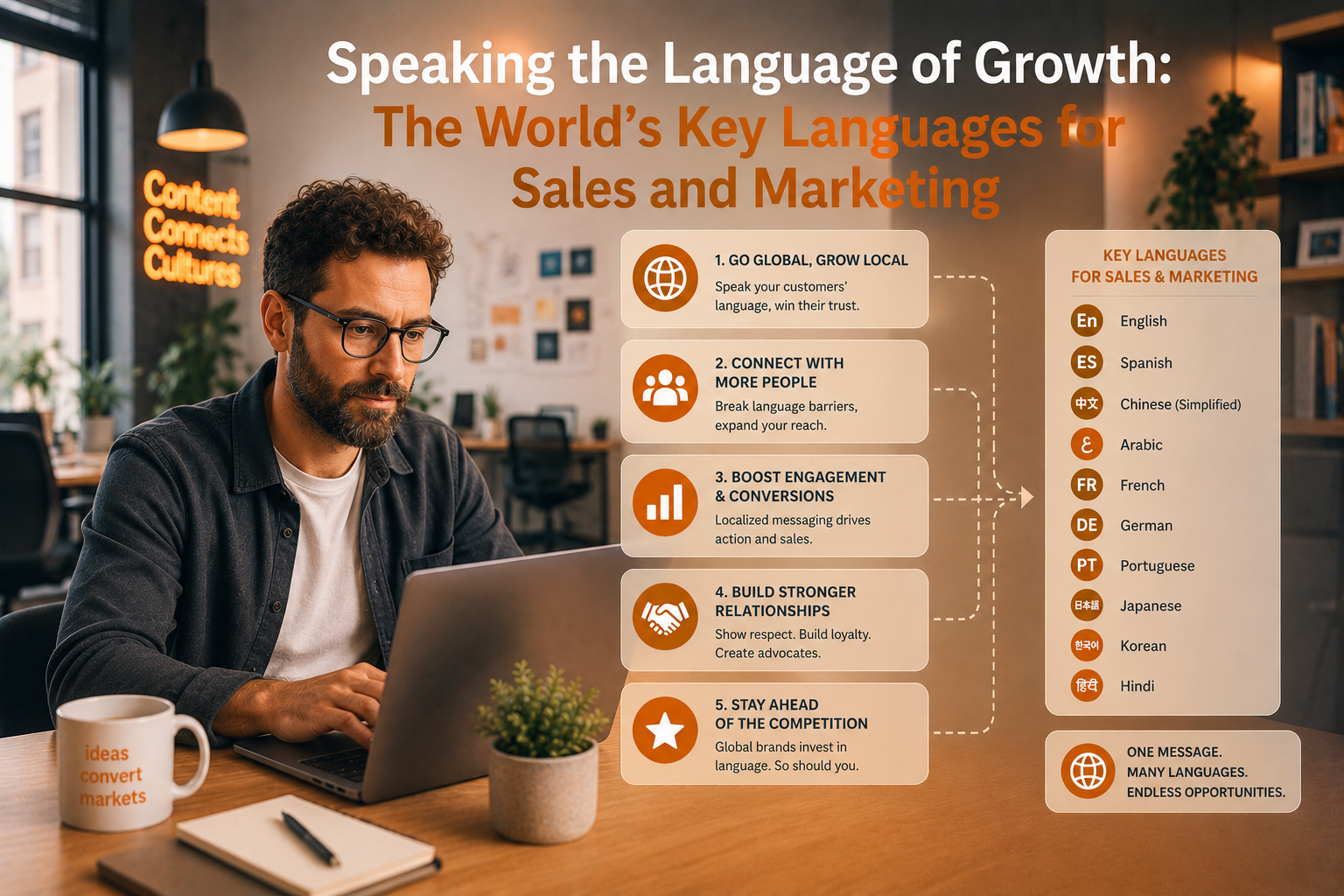
English remains hugely important within international business and is widely used across global trade, technology and professional communications. However, relying on English alone can significantly limit a brand’s ability to engage customers in their preferred language.
Mandarin Chinese provides access to one of the world’s largest consumer markets, while Spanish connects businesses with audiences across Spain, Latin America and large communities within the United States.
French has significant commercial relevance across Europe, Canada and numerous rapidly developing African markets, while Arabic connects businesses with consumers across the Middle East and North Africa.
Other commercially important languages include German, Portuguese, Japanese, Korean and Hindi, each providing access to substantial regional economies and consumer audiences.
However, choosing a language shouldn’t simply be about the number of people who speak it. Businesses need to consider where their customers are, their purchasing power and the markets offering the greatest opportunity for growth.
Translation Is Only the Beginning
Successful international marketing isn’t achieved by translating an English campaign word-for-word.
This is where localisation becomes essential.
Localisation adapts communication for a particular country, culture or audience. That might mean changing terminology, imagery, humour, currencies, measurements, calls to action or even the products being promoted.
Spanish provides a simple example. Content created for customers in Madrid may require different vocabulary and cultural references from a campaign targeting Mexico, Argentina or Colombia.
Similarly, Arabic-speaking markets aren’t one homogeneous audience. Regional dialects, cultural expectations and buying behaviours can vary considerably.
The language might technically be correct while the marketing itself feels completely wrong.
Why Customers’ Languages Matter
Marketing is ultimately about creating connection and trust.
Customers are more likely to engage with content they can easily understand, particularly when researching products, comparing services or making purchasing decisions.
Providing localised websites, advertising, product information, social content and customer communications can make an international organisation feel considerably more accessible.
It also demonstrates something important: the business has invested in understanding that market.
Think Global, Communicate Local
Modern technology has made multilingual marketing faster and more scalable. AI translation, machine translation and automated workflows can help businesses process enormous volumes of content across multiple languages.
But technology works best alongside professional linguistic and cultural expertise.
A human linguist can recognise whether a headline sounds natural, whether humour translates successfully or whether a particular phrase could have an unintended meaning locally.
For ambitious businesses, translation shouldn’t therefore be viewed simply as an operational cost. It can become part of the wider international growth strategy.
Global expansion creates the opportunity to reach millions of new customers.
Translation makes your message understandable.
Localisation makes it relevant.
If you’re trying to scale multilingual content without overspending, contact us at info@one-global.com to focus budget on the markets, pages, and localisation choices most likely to generate qualified traffic and commercial return.
To read more on our services, news and industry trends visit our blog page HERE.