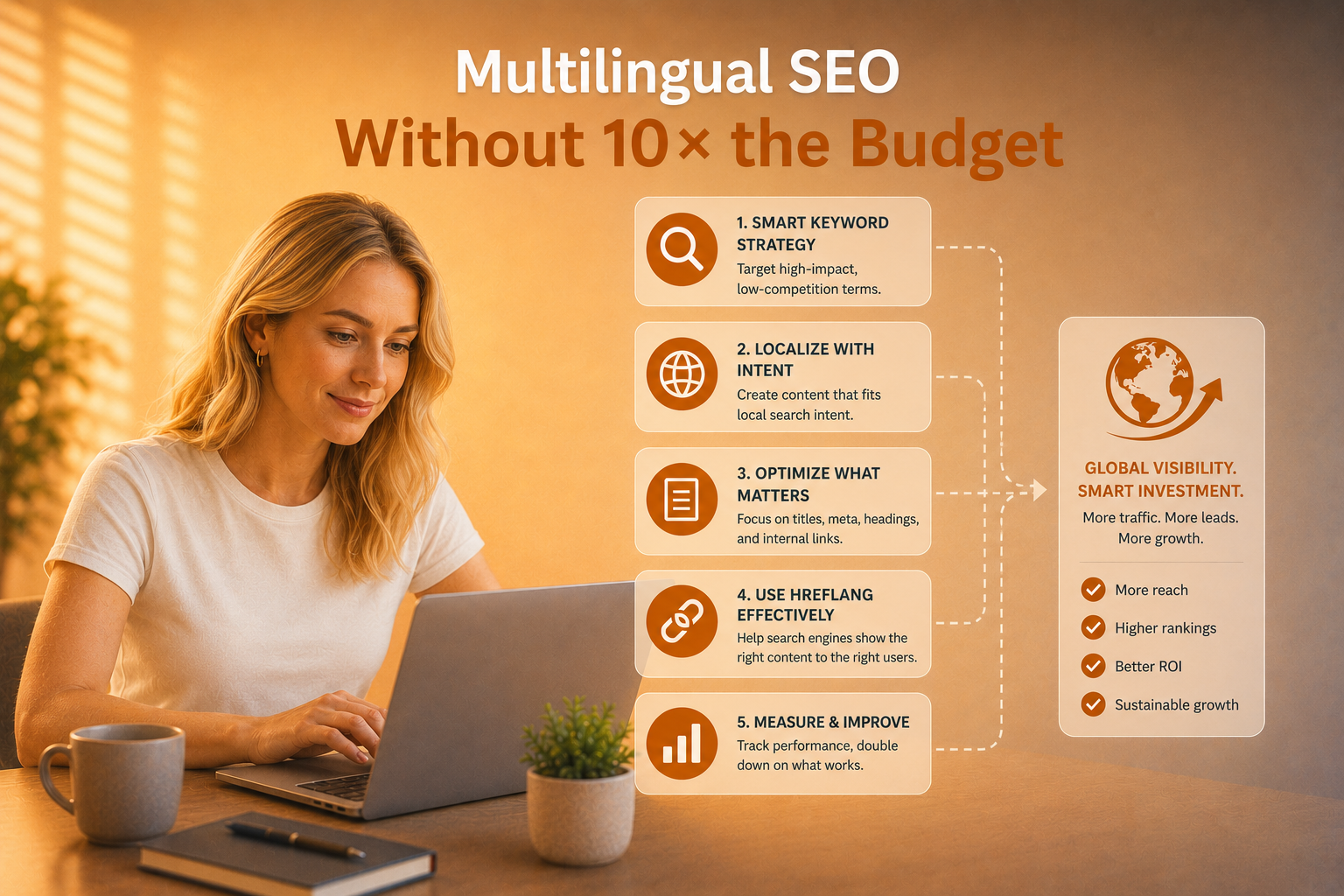
Multilingual SEO Without 10× the Budget
A lot of multilingual SEO plans become expensive for the wrong reasons.
Teams translate too many pages too early. They assume keywords can be converted directly from English. They launch market versions before the CMS or technical setup is ready. Or they try to replicate the same SEO effort across every locale at once, as if scale alone will create results.
Usually, it doesn’t.
A stronger multilingual SEO strategy is selective. It focuses investment where search demand, commercial value, and operational feasibility overlap. It treats some pages as translation candidates, others as transcreation candidates, and many as lower priority until the business case becomes clearer.
That’s how teams grow internationally without multiplying effort by ten.
Start with market selection, not universal rollout
One of the biggest budget mistakes is trying to localise SEO content for every possible market in parallel.
A better approach is to decide where localisation is likely to create meaningful return. That means looking at market demand, commercial priority, local competition, and the business’s ability to support the resulting traffic. A market may look attractive in theory, but if the site structure, product availability, or local support model is not ready, SEO investment can outpace operational readiness.
This is where a shortlist matters. Not every promising market needs to be activated at once.
Translate some pages, adapt others
Not all pages deserve the same treatment.
Evergreen educational content, straightforward category pages, and lower-risk support content may translate relatively efficiently if the original structure is strong. By contrast, high-conversion landing pages, product messaging, and campaign-led content often need local keyword validation and more adaptation. Literal keyword translation is one of the fastest ways to produce pages that are technically localised but commercially weak.
Good multilingual SEO is rarely about choosing translation or transcreation as a universal rule. It is about matching the method to the page purpose.
Lightweight keyword research still matters
Budget-conscious does not mean keyword-blind.
Teams don’t always need full-scale local SEO research to make good decisions, but they do need enough local validation to avoid obvious mistakes. Sometimes that means confirming whether the translated keyword is actually used. Sometimes it means spotting a difference in intent, search volume, or SERP behaviour that changes the content plan.
This matters particularly across EU and APAC markets, where literal equivalence can hide very different search habits.
Get the technical basics right
You don’t need a huge budget to get the foundations right, but you do need discipline.
Hreflang, canonical logic, URL structure, indexing rules, and local page relationships all need to be set up properly. If they are wrong, even well-localised content may not perform as intended. Wrong hreflang, duplicate content patterns, or weak CMS implementation can waste good localisation effort.
This is one of the clearest examples of why multilingual SEO is not just a content exercise. It is a workflow and systems exercise too.
Reuse patterns intelligently
A scalable multilingual SEO programme often depends on repeatable page patterns.
That could mean using structured templates for local landing pages, applying selective transcreation only where needed, or validating a smaller set of high-value keywords rather than trying to build a fully bespoke strategy for every page in every market. The point is not to cut corners. It is to direct effort where it changes performance.
Where a consultative partner helps
At One Global, we find that many teams don’t need more content volume first. They need a clearer localisation strategy around the content they already plan to create.
That means helping them decide which markets to prioritise, which pages need heavier adaptation, where technical constraints in the CMS may limit rollout, and which keyword choices need local validation before money is spent building pages around them.
If you’re trying to scale multilingual SEO without overspending, contact us at info@one-global.com to focus budget on the markets, pages, and localisation choices most likely to generate qualified traffic and commercial return.