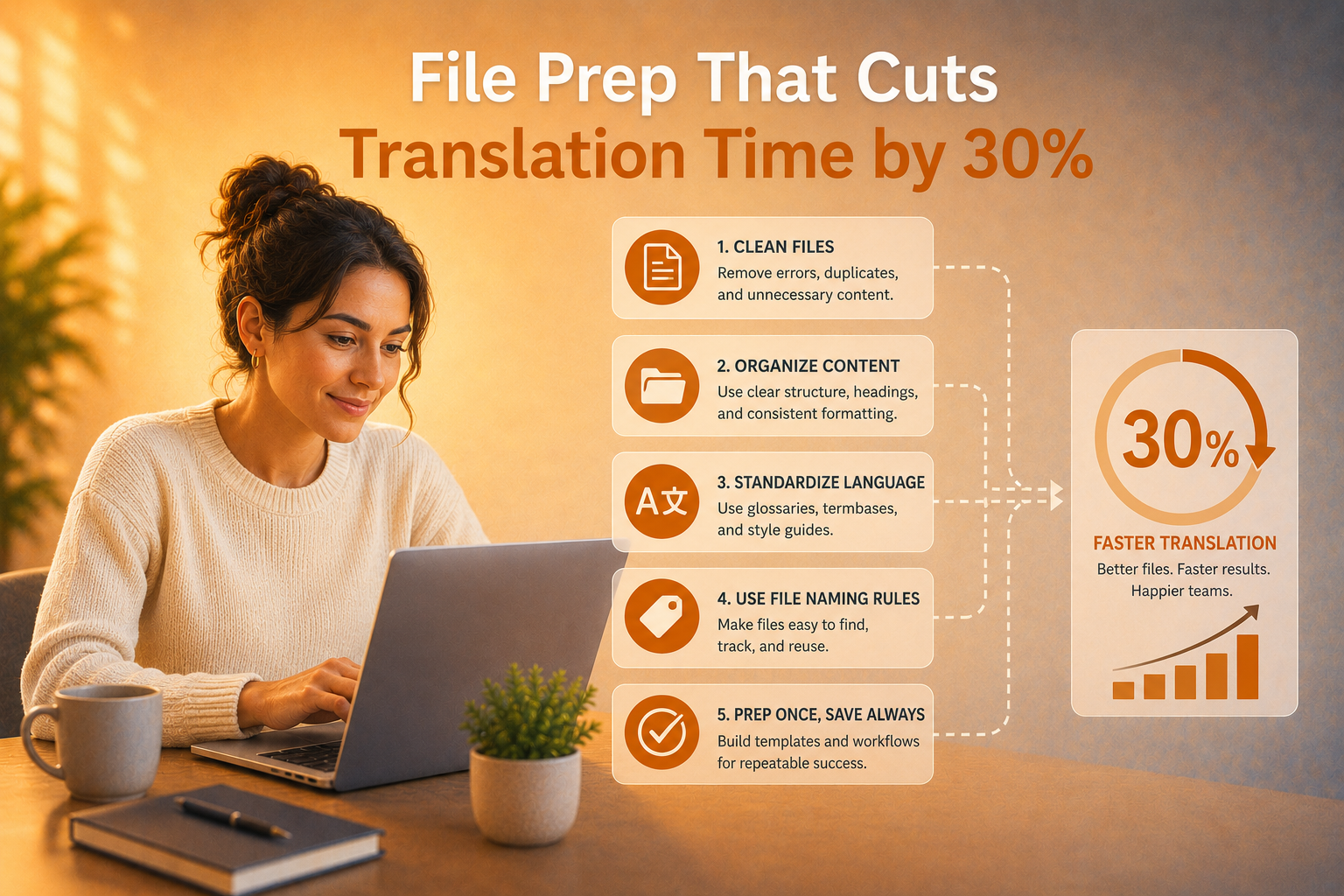
File Prep That Cuts Translation Time by 30%
Translation projects often slow down long before a linguist ever sees the content.
The cause is usually not the text itself. It is the way the files were prepared. Embedded text, broken styles, inconsistent placeholders, hard-coded strings, poor exports, and cluttered design files all create avoidable work. That work shows up later as engineering time, manual cleanup, DTP effort, tag issues, or lengthy QA. By the time teams feel the delay, the root cause is often several steps upstream.
That’s why file preparation is not an admin detail. It’s a workflow lever.
Editable text saves time immediately
One of the quickest ways to make a project more expensive is to leave text baked into visuals.
Once text lives inside an image, translation becomes a design and engineering problem, not just a language task. Someone has to extract it, recreate it, or rebuild the asset later. That adds time and introduces risk. It is especially painful in fast-moving content such as marketing collateral, product visuals, training assets, or market research outputs with charts and callouts.
Whenever possible, text should stay editable and separated from the visual layer. That sounds obvious, but it’s still one of the most common sources of avoidable delay.
Structure matters more than teams expect
Clean file structure reduces friction throughout the whole workflow.
That means using consistent styles, logical layer naming, sensible paragraph and character styles, stable components, and clear variable placeholders. It also means avoiding one-off formatting hacks that make sense in the moment but create ambiguity later.
A well-prepared file translates faster because fewer decisions have to be reverse-engineered. The translation tool can process it more cleanly, the linguist sees fewer fragmented strings, and the QA team spends less time checking whether problems are linguistic or structural.
Variables and tags need discipline
Placeholder and tag handling is one of the least glamorous parts of localisation, but it’s often where avoidable breakage happens.
If variables are named inconsistently, if placeholders are embedded awkwardly in text, or if tags are handled differently across files, the result is fragile content. A translation can be correct and still fail in build because the structure around it was unstable.
This is especially important in product UI, survey platforms, templates, and automated publishing environments where small tag errors can affect the final output significantly.
Export choices shape the translation path
Different tools create different localisation routes.
A Word file, Figma export, InDesign package, PowerPoint deck, or HTML extract won’t behave the same way once they enter the workflow. Good file prep means understanding what the next stage needs and exporting accordingly. Whenever possible, the source should move into a genuinely translatable format, not a format that simply looks shareable.
This is where teams often lose time without realising it. A convenient export for internal circulation is not always a good source for translation.
Common problems by file type
InDesign files often suffer from inconsistent styles, overset text, or local formatting decisions that don’t survive expansion well. Figma files often include flattened text, duplicated components, or labels hidden in layers that are easy to miss. Word files can contain tracked changes, manual formatting, and structural inconsistency that makes extraction harder than expected.
The exact issues differ, but the principle is the same: the more structured the source, the cleaner the translation path.
Better prep reduces engineering and DTP effort
The real value of good file prep is not just speed. It is cleaner downstream execution.
When files are prepared properly, engineering effort drops, DTP rework shrinks, and QA becomes more focused. Teams spend less time fixing preventable structural problems and more time checking the quality of the actual output.
At One Global, this is one of the quickest areas where we can often help clients save time without changing much about the content itself. A few practical fixes to file structure can have a disproportionate impact on translation speed and rework.
If file issues are slowing your projects down, contact us at info@one-global.com to identify the quickest fixes that reduce translation time, cut rework, and stop preventable file-prep problems from driving up cost later in the workflow.