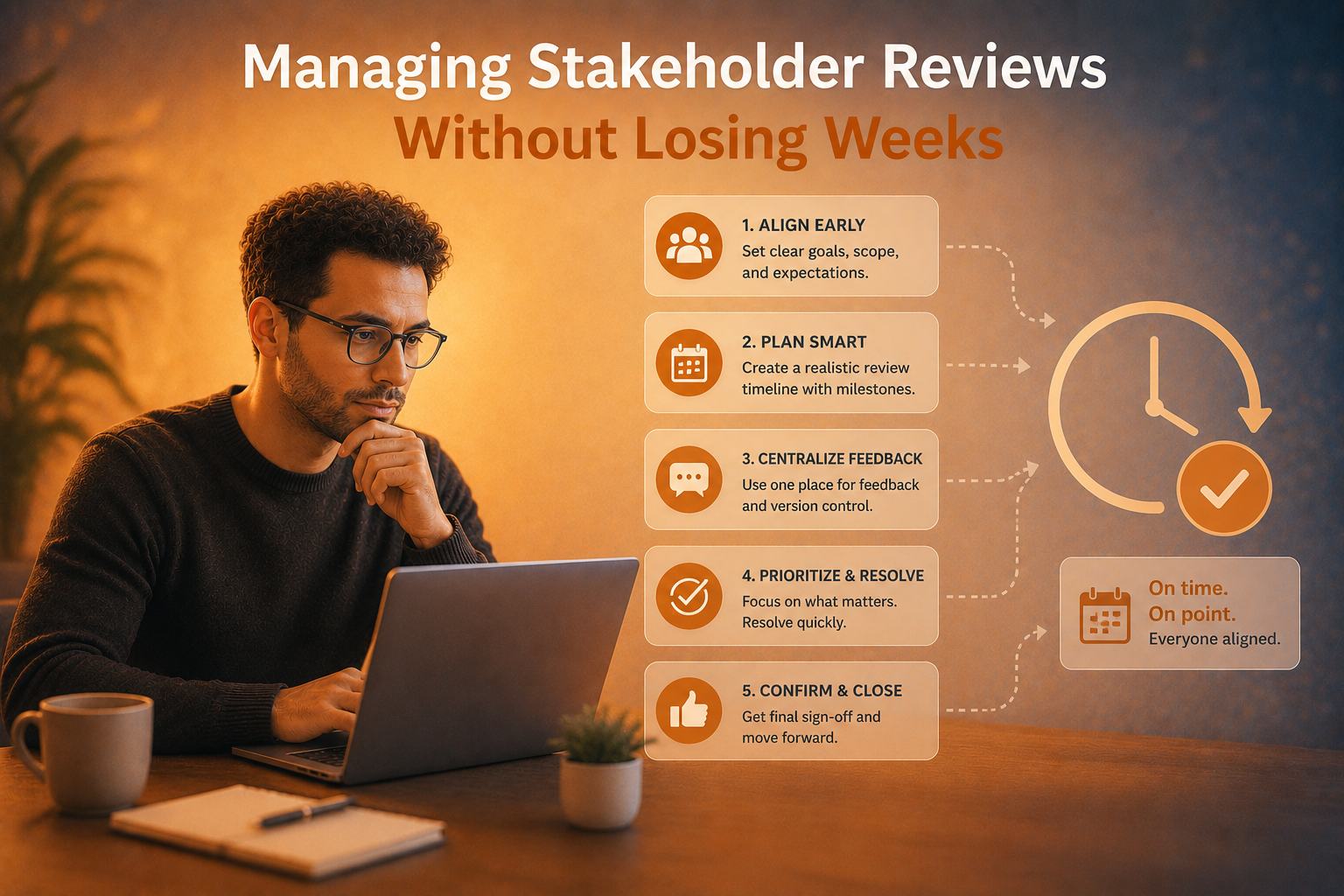
Managing Stakeholder Reviews Without Losing Weeks
Stakeholder review is supposed to improve quality. In many multilingual projects, it’s also where timelines begin to slide.
The issue is rarely that review exists at all. Review is often valuable, especially when content touches brand, product accuracy, legal language, or local market expectations. The problem is that review is frequently set up too loosely. Too many people comment. Roles are unclear. Feedback arrives in different formats. Reviewers are asked to assess everything at once. Comments contradict each other. Then the project team spends days trying to interpret, consolidate, and resolve points that should have been structured from the start.
That is how a short review stage turns into a multi-week delay.
The good news is that this usually isn’t a people problem. It’s a process problem. A light framework can speed review significantly without making stakeholders feel boxed out.
Choose reviewers deliberately
One of the most common causes of delay is involving people without defining why they are there.
Not every reviewer needs to comment on tone, terminology, legal accuracy, and product meaning all at once. A much better approach is to assign roles clearly. One reviewer may be best placed to check market naturalness. Another may need to confirm technical accuracy. Another may act as final approver for brand alignment. Once those functions are separated, feedback becomes easier to interpret and much easier to prioritise.
This also helps reduce over-editing. When every stakeholder feels entitled to rewrite from personal preference, the review process becomes subjective by default.
Calibrate before the full review begins
A small sample can save a great deal of time.
Before sending a large volume of content for review, it helps to align on a short sample pack. This can include a few examples of tone, terminology, formatting, and decisions likely to come up later. It gives reviewers a concrete reference point and helps surface disagreements early, when they are still manageable.
This calibration step is especially useful when the reviewers are new, when the content is high-profile, or when the team has previously run into inconsistent market feedback.
Without calibration, many review rounds end up being less about the content itself and more about late alignment on standards.
Make feedback easier to process
Review slows down when every comment arrives with equal weight.
A simple feedback code system makes a big difference. Critical issues should be separated from preferred edits, optional stylistic suggestions, and general observations. That lets the project team triage properly instead of treating everything as equally urgent.
It also improves reviewer behaviour. Once stakeholders know the categories, they are more likely to distinguish between what must change and what they would simply phrase differently.
This is where many teams save time without lowering standards.
Set deadlines, ownership, and final approval rules
Review cycles drag when no one knows when input closes or who has the authority to settle a disagreement.
A cleaner setup defines three things early: when feedback is due, who consolidates it, and who gives final sign-off. That single source of truth is often the difference between a smooth cycle and comment ping-pong.
It also protects reviewer goodwill. People are much more likely to engage constructively when the process feels organised and finite.
Why multilingual review gets messy so quickly
Multilingual stakeholder review adds complexity because feedback is harder to compare across markets.
A central team may not be able to evaluate local comments directly. A local reviewer may not see how a terminology choice affects consistency across other languages. A product team may care about accuracy, while a market team cares about tone. None of those perspectives are wrong, but without structure they collide.
That’s why multilingual review works best when the team has agreed in advance what is being reviewed, which comments take precedence, and how conflicts will be resolved.
Review should protect quality, not create delay
At One Global, we usually see the same pattern: the fastest review cycles are not the ones with the fewest stakeholders, but the ones with the clearest boundaries. A light reviewer pack, a calibrated sample, severity codes, deadline discipline, and one final decision-maker can remove a surprising amount of friction.
That helps teams shorten cycles without lowering the bar. It also improves sign-off quality, because reviewers spend more time on the decisions that matter and less time re-litigating basic preferences.
If stakeholder review is slowing projects down, contact us at info@one-global.com to build a leaner review structure that protects quality, speeds sign-off, and cuts the avoidable delay that keeps dragging multilingual work off schedule.