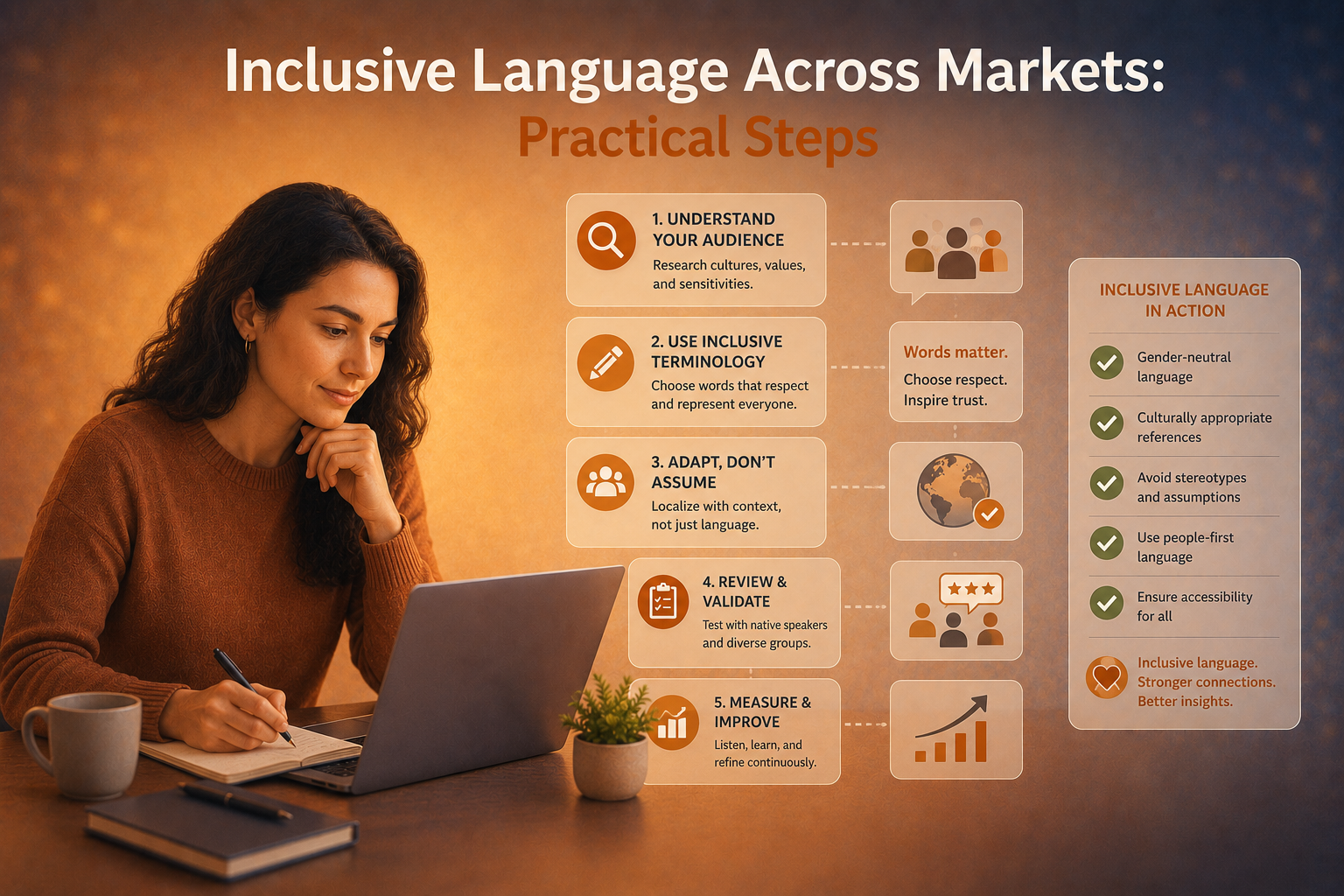
Inclusive Language Across Markets: Practical Steps
Inclusive language is often reduced to a narrow question of wording: which terms are acceptable, which ones feel outdated, and which alternatives are preferred. That matters, but it’s only part of the picture.
In practice, inclusive content is content that more people can understand, navigate, and trust. That includes language choices, but it also includes structure, accessibility, forms, layouts, and the assumptions built into how content is written in the first place. A sentence can be technically respectful and still be difficult to process. A form can use neutral wording and still exclude people through rigid fields or inaccessible design. A translation can be accurate and still fail if the original content was never built for broad usability.
For global teams, this gets more complex quickly. Inclusive language doesn’t work well as a universal list imposed in the same way across all markets. Expectations differ. Legal contexts differ. Social sensitivities differ. What reads as clear and inclusive in one market may feel awkward, overly formal, or culturally off-key in another. The goal is not to force identical wording everywhere. It is to make content more usable and respectful in each market without losing clarity or creating new confusion.
Start with plain language, not policy language
One of the most practical inclusive steps any team can take is to write more plainly.
Plain language helps more users than many teams realise. It supports readers with different literacy levels, people reading in a second language, users under time pressure, and anyone accessing content through assistive technology. It also gives translators a stronger source to work from. Overwritten English becomes even harder to process once translated. Long sentences, abstract phrasing, and vague instructions create friction that multiplies downstream.
That doesn’t mean all writing needs to sound flat or stripped of character. It means instructions should be direct, sentence structure should be manageable, and key ideas should not be hidden inside brand-heavy phrasing. Inclusive content often starts by removing unnecessary barriers rather than adding more explanation.
Avoid idioms, cultural shorthand, and hidden assumptions
A lot of exclusion happens quietly.
Idioms are a common example. Phrases that feel friendly and natural in English can become confusing, overly literal, or simply meaningless in translation. The same applies to cultural shorthand, humour that depends on local references, or assumptions about what people know, how they live, or how they identify themselves.
Forms are another area where hidden assumptions show up fast. Titles, required gender fields, name structures, relationship categories, and consent language can all create unnecessary friction. Some of these issues sit at the writing level. Others sit in product or design decisions. Either way, they affect whether users feel the content or experience was built with them in mind.
That’s why inclusive language shouldn’t be treated as a last-stage wording polish. It often requires upstream decisions about source content and layout.
Accessibility is part of inclusive language
Inclusive language and accessibility shouldn’t be separated.
Alt text, heading hierarchy, readable form labels, sensible link text, captioning, colour contrast, and clear navigation all affect whether content is actually usable. A piece of copy may be beautifully rewritten for inclusivity, but if the page structure is poor or the form flow is inaccessible, the experience still fails a large portion of users.
This is particularly important in multilingual work, because accessibility issues are easy to miss when teams focus only on translation accuracy. A localised page can look finished while still containing inaccessible components, broken reading order, weak labels, or poor screen-reader behaviour.
In practice, inclusive localisation is stronger when language review and accessibility thinking happen together rather than in separate tracks.
Locale sensitivity matters
This is where global teams often need more nuance.
Some inclusive language questions are genuinely market-specific. Formality norms, gendered language, disability terminology, references to age, family structure, or identity, and even expectations around directness can all vary. A phrase that feels helpfully explicit in one market may feel unnatural in another. A neutral construction in one language may not map neatly into another without becoming awkward or overly bureaucratic.
That doesn’t mean teams should avoid trying. It means they need local judgement, not just a central list.
For example, some EU markets may expect more explicit accessibility wording in regulated or public-facing contexts, while some APAC markets may respond better to clarity and usability improvements that avoid overly performative phrasing. The inclusive choice is not always the most visible one. Often it is the one that makes the interaction clearer and more respectful without drawing unnecessary attention to itself.
Review with real readers in mind
One of the most useful checks is simply this: who might struggle with this content, and why?
That question tends to reveal more than a token list of approved and banned words. It helps teams think about different reading needs, different cultural expectations, and the actual task the user is trying to complete. It also helps shift the conversation away from symbolic compliance and towards practical usability.
A good review process looks at more than vocabulary. It asks whether the message is clear, whether the assumptions are too narrow, whether the form or layout introduces barriers, and whether the translated version still feels natural in-market.
Make it workable, not performative
Inclusive language works best when it improves understanding and trust. It works worst when it becomes a performative layer added on top of unclear content and inaccessible design.
At One Global, we find the most useful approach is usually practical rather than ideological. Start with plain language. Remove unnecessary assumptions. Check forms, layouts, and accessibility basics. Then review with local context in mind so the result feels usable, not imported.
If you’re reviewing content across markets, contact us at info@one-global.com to make it clearer, more usable, and more inclusive without adding the friction, ambiguity, or inconsistency that slows teams down later.