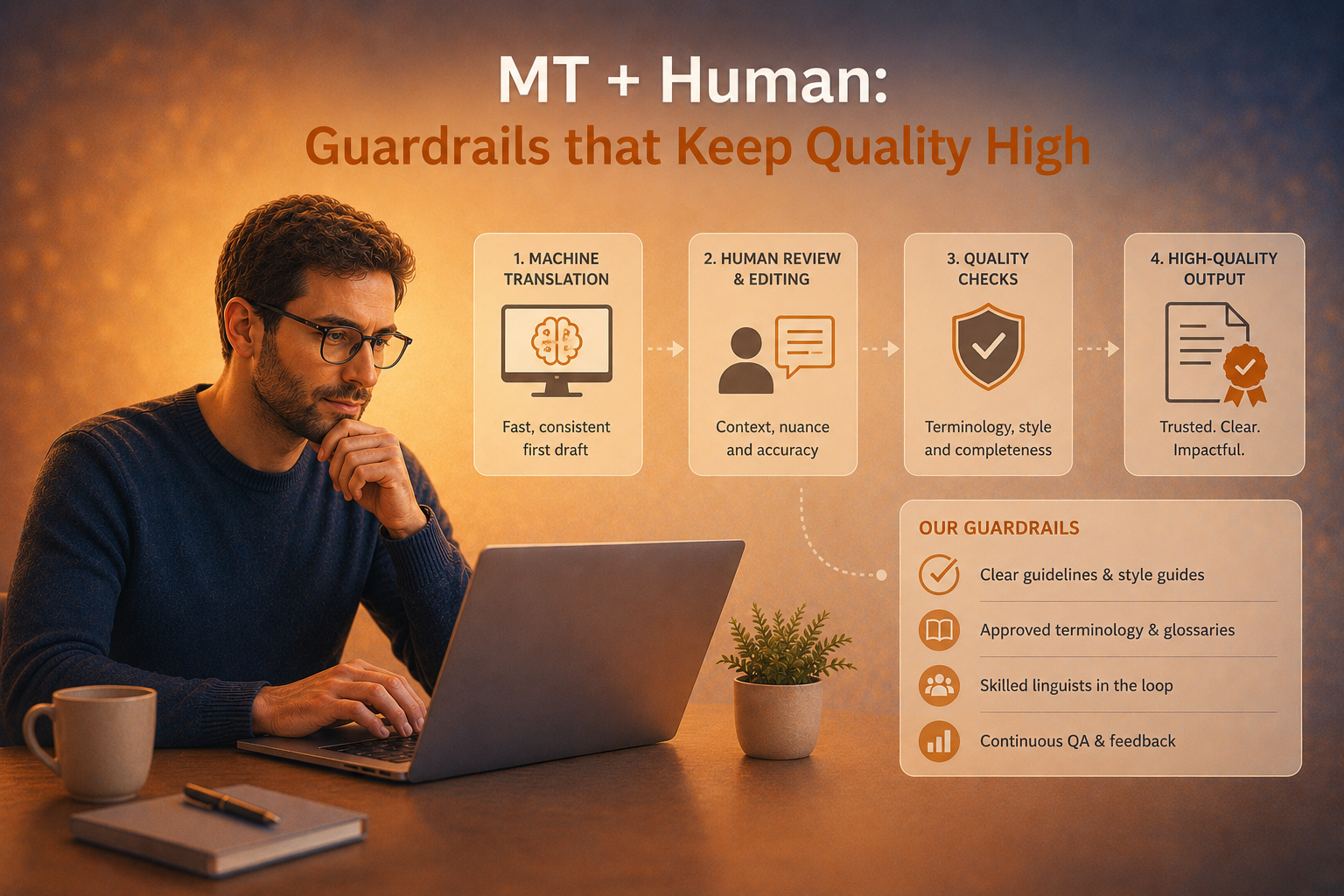
MT + Human: Guardrails that Keep Quality High
Machine translation is no longer a fringe workflow. For many content types, it’s now part of normal production. The question is no longer whether MT can be used. It’s where it fits, what risks it creates, and what controls keep the output useful.
Used well, MT plus human review can improve speed and reduce cost. Used badly, it can create privacy issues, weak brand language, and false confidence in content that was never suitable for the workflow in the first place.
Start with a fit-for-purpose view
The safest MT decisions begin with content type, not technology enthusiasm.
Low-risk, repetitive, and structurally simple content is usually the best place to start. Support articles, internal reference material, and standard operational content may be good candidates if the source quality is stable. Highly emotive copy, creative marketing, nuanced qualitative material, and regulated content often need more caution.
That doesn’t mean MT is unusable in sensitive environments. It means the workflow needs much tighter controls.
A fit-for-purpose approach is what stops MT from becoming a blunt instrument. The question is not “can the engine translate this?” It’s “does this content type support an MT-assisted workflow without unacceptable risk to tone, compliance, privacy, or trust?”
Data handling can’t be an afterthought
One of the biggest gaps in MT adoption is unmanaged access.
If teams paste source content into unapproved tools, or use public systems without clear policy, they create unnecessary data exposure. That risk increases with confidential research, personally identifiable information, regulated documentation, and internal strategic material.
A responsible MT workflow should define which tools are allowed, what content can enter them, what must be redacted first, and who is authorised to use them.
This is where many organisations need clearer guardrails than they realise. The technical decision is only part of it. The governance decision matters just as much. Even a strong MT model becomes risky if access is uncontrolled.
Post-editing needs a real brief
Human review only works well if reviewers know what they’re trying to achieve.
A weak post-editing brief creates inconsistent results. Some editors rewrite heavily. Others only fix obvious errors. Some preserve source structure too rigidly. Others smooth everything into a different tone. That’s not a quality model. It’s a guessing game.
Good PE guidance should explain content purpose, target audience, tone expectations, risk level, and the threshold for intervention. Editors need to know whether the aim is publication-ready copy, internal usability, or light readability improvement.
That clarity matters because post-editing is not one single task. The right intervention threshold for a knowledge-base article is not the same as for customer-facing product copy. Without clear instructions, quality becomes reviewer-dependent rather than process-driven.
Metrics should reflect the goal
Quality measurement often becomes too abstract in MT discussions.
The useful question is not whether the output was good. It’s whether the workflow produced the right quality for the content type, safely and consistently. Metrics like edit distance, error categories, turnaround, reviewer effort, and post-release issues are usually more helpful than generic impressions.
For pilot programmes, compare outcomes across defined content types rather than trying to prove a universal result.
Some teams also benefit from measuring where effort concentrates. If editors spend most of their time correcting terminology, then the problem may be terminology control rather than MT itself. If tone and fluency keep failing, the content may simply not be a strong fit for the workflow. Metrics are useful when they support better decisions, not when they are collected for their own sake.
Regulated and non-regulated content shouldn’t be treated the same
This is where guardrails matter most.
In non-regulated environments, teams may have more room to test lighter workflows. In regulated settings, privacy, traceability, terminology accuracy, and approval discipline are often much more important. The workflow can still be efficient, but the controls have to match the risk.
That usually means stronger process boundaries, better tool discipline, and much clearer rules about what content can and cannot enter an MT-assisted path.
Keep the pilot contained
The safest way to build confidence is with a small, clearly bounded pilot. Pick low-risk content. Redact sensitive information where needed. Define the post-editing brief. Decide the metrics in advance. Then review the outcomes honestly.
A contained pilot also makes expectation-setting easier. It lets teams learn where the workflow helps, where it doesn’t, and what kind of human review actually keeps quality high.
Guardrails make the workflow usable
MT can be useful, but only when expectations are realistic and control is deliberate.
At One Global, we find the most successful MT + human workflows are not the most aggressive. They’re the ones with the clearest rules: suitable content types, managed access, clear PE briefs, sensible metrics, and honest evaluation. That’s what turns MT from a risky shortcut into a controlled production model.
If you’re exploring MT-assisted workflows, contact us at info@one-global.com to put the right guardrails in place from the start, so you can improve speed and efficiency without creating avoidable risk for quality, privacy, or brand trust.