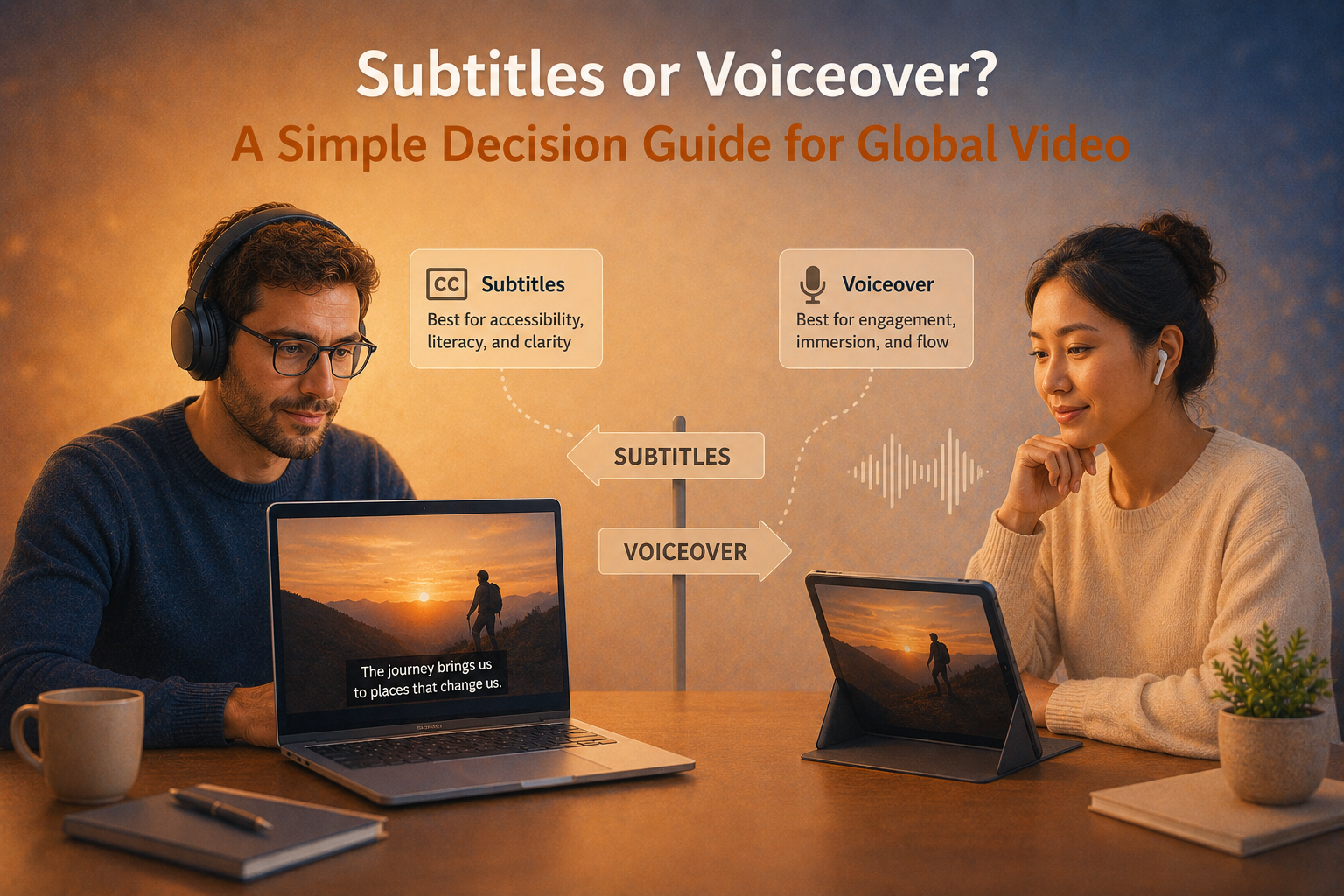
Subtitles or Voiceover? A Simple Decision Guide for Global Video
Video is now a common part of global content, but the localisation choice is often treated as simpler than it really is.
Teams assume subtitles are the cheap option and voice-over is the premium option. Sometimes that’s true. Often it isn’t enough to guide the decision.
The right choice depends on audience, message, pace, tone, and how much information the viewer is expected to absorb on screen.
When subtitles are enough
Subtitles work well when the original audio can remain, the pace is manageable, and the viewer isn’t being asked to read too much at once.
They are usually a strong choice for interviews, social clips, event highlights, internal research summaries, and explainers where the spoken delivery is relatively clear and the visuals don’t already carry too much text. They are also more flexible for multi-market rollouts because they’re faster to adapt and easier to update.
But subtitles only work when reading speed and density are controlled. If a video contains long spoken sentences, heavy jargon, multiple speakers, or lots of on-screen text, subtitles can become a burden rather than a benefit.
This is where many teams misjudge the format. Subtitles look cheaper and simpler upfront, but if the content is too dense, the audience experience becomes harder than intended. A lower-cost choice on paper can become less effective in practice.
When voice-over adds value
Voice-over becomes more useful when you need the audience to listen rather than divide attention.
That’s especially true for marketing content, training, help content, and brand-led explainers where tone matters and the message needs to feel more natural in-market. It can also work better for audiences less likely to tolerate dense subtitle reading, or when the visuals already demand a lot of attention.
Voice-over is not automatically better. But it can deliver a smoother experience when subtitles would force too much reading or flatten the intended tone.
It’s also useful when the content depends heavily on persuasion, emotion, or spoken reassurance. In those cases, keeping the message audible in the target language may carry more value than preserving the original voice.
Reading speed changes everything
This is one of the biggest decision points. A script that feels comfortable in English may become harder to subtitle cleanly in German, French, Arabic, or Spanish simply because the text expands or requires more explicit phrasing. If the subtitle window can’t carry that comfortably, viewers either miss information or stop reading.
That’s why subtitle viability is not just a content decision. It’s a timing and density decision.
It’s also why script adaptation matters. A voice-over script may need light rewriting to sound natural aloud. A subtitle script may need compression to remain readable. The goal is not to mirror every spoken word exactly. It’s to preserve the intended message in a format the viewer can realistically process.
Do not forget on-screen text
Video localisation is rarely only about the spoken audio.
If charts, titles, labels, product screens, or animated text appear on screen, those elements need to be considered as part of the same experience. A well-subtitled video can still fail if the viewer is simultaneously trying to read untranslated on-screen text.
The more visual text a video contains, the more carefully subtitles and voice-over need to be weighed. Sometimes the right answer is not only subtitles or only voice-over, but a broader localisation pass that addresses both spoken and visual language together.
This becomes especially important in product demos, training flows, and video with UI screens, where viewers are already splitting attention between narration and interface.
Quality checks matter whichever route you choose
For subtitles, QA should check timing, reading speed, line breaks, consistency, speaker changes, and whether the subtitle load is realistic alongside the visuals. For voice-over, QA should check tone, pacing, pronunciation, sync expectations, and whether the adapted script still sounds like the brand.
Accessibility also matters. Teams shouldn’t ignore the distinction between open and closed captions, especially when publishing across channels with different viewing habits. Accessibility is not an optional add-on. It affects who can actually use the content and how.
Make the decision based on use, not habit
Subtitles are not always the budget route, and voice-over is not always the premium route. The best choice is the one that helps the audience absorb the message without unnecessary effort.
If the content is short, visually light, and still benefits from the original speaker, subtitles may be enough. If the message is dense, brand-sensitive, or easier to hear than read, voice-over may add real value.
At One Global, we usually find the strongest decisions come from looking at the actual clip, not relying on assumptions about format. A 60-second interview excerpt, a product demo, and a brand film may all need different treatment even if the budget line is similar. If you’re deciding between subtitles and voice-over, contact us at info@one-global.com to choose the right localisation route for your content, and avoid spending budget on a format that makes the message harder for global audiences to absorb.
To read more of our blogs and news visit our news section here.