Style Guides that Improve Translation Quality
A style guide should reduce friction. Too often, it creates more of it.
Many style guides are either too broad to be useful or too thin to guide real decisions. They say things like “be friendly” or “sound premium” without showing what that means in practice. That leaves translators and reviewers to interpret the tone for themselves, which usually leads to more subjective edits, longer sign-off cycles, and inconsistent voice across markets.
A good localisation style guide does something simpler and more valuable. It turns tone into workable instructions.
What a useful style guide includes
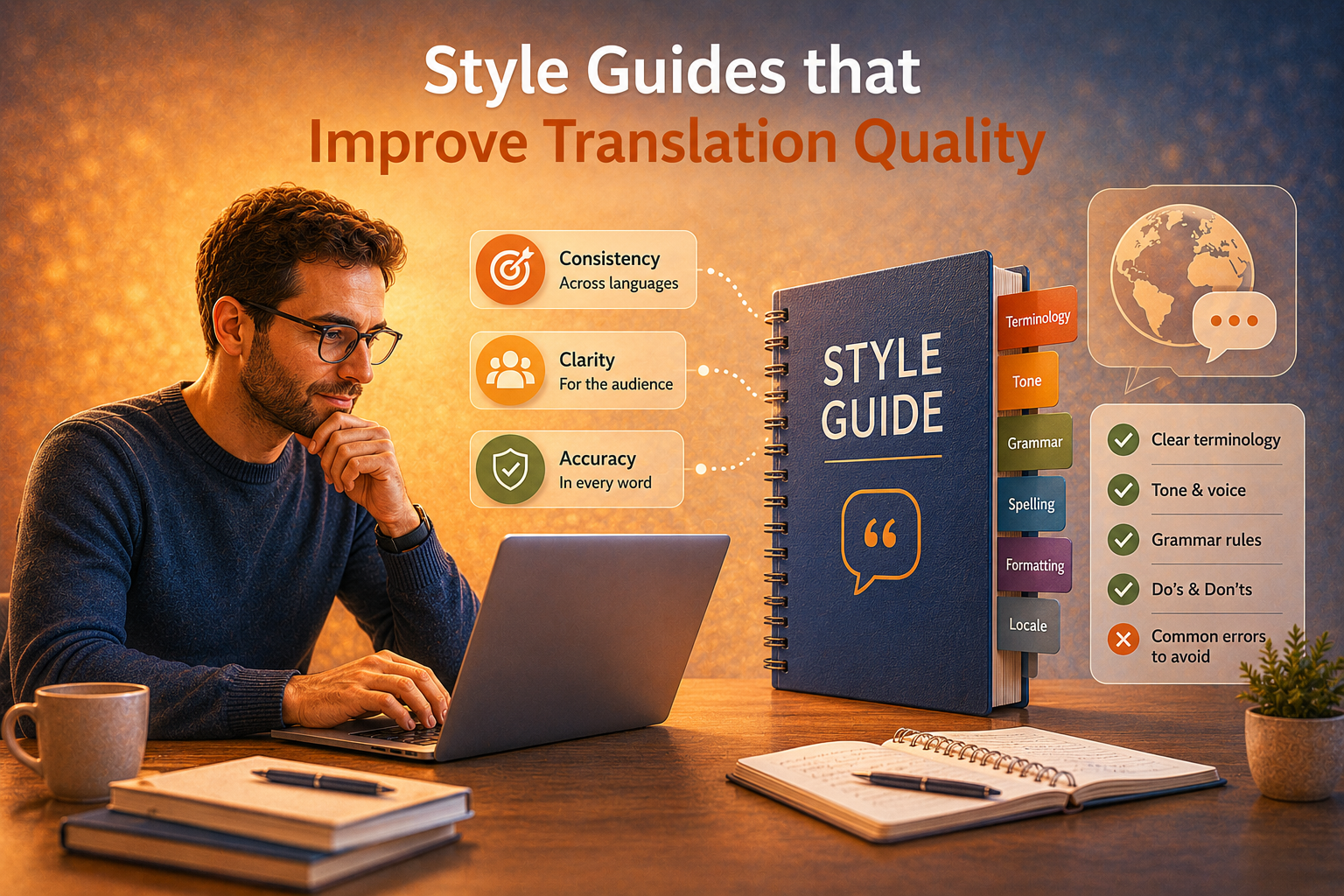
At a minimum, a style guide should clarify voice, tone, punctuation, formatting, grammar preferences, audience expectations, and locale-specific rules. But the most useful part is usually not the rules alone. It’s the examples.
A translator can work with “use contractions in US English, avoid them in high-formality contexts, and keep calls to action direct” much more easily than “sound warm but professional.” The same is true for punctuation, sentence length, date formats, numerals, capitalisation, and product naming conventions.
Examples show what good looks like. Rules without examples invite interpretation.
A useful guide also distinguishes between absolute rules and preferences. Some items should never vary, such as product naming or legal disclaimers. Others may flex by channel, market, or audience. That distinction helps reviewers comment more consistently and stops teams from over-policing low-risk style choices.
Voice and tone need to be separated
This is where many teams get stuck.
Voice is what stays stable across content. Tone is what changes depending on context. A style guide should help users distinguish between the two. If the brand is generally clear, confident, and helpful, that voice may stay consistent. But a support article, onboarding email, product banner, and campaign landing page may all use different tonal settings.
Without that distinction, reviewers often push for blanket consistency in places where some flexibility is actually appropriate. That slows translation and weakens content because teams end up trying to force one tone into every situation.
A stronger guide explains how the brand should sound in different contexts, not just how it sounds in theory.
Locale differences need to be made explicit
A global style guide is not enough on its own.
If you’re working across English variants, even simple choices can create friction. EN-US and EN-GB differ on spelling, punctuation habits, date styling, vocabulary, and sometimes tone expectations. If your style guide ignores those points, teams end up debating details in review that should already have been settled.
The same logic applies beyond English. Local preferences around politeness, directness, punctuation, number formats, or CTA intensity shouldn’t be left to memory. If the brand likes short, direct calls to action in US English, that doesn’t automatically mean the same degree of directness will feel natural in German, Japanese, or French.
A useful style guide doesn’t flatten these differences. It makes them visible so linguists and reviewers can make better decisions without starting from zero each time.
Why generic guides fail
The most common problems are predictable.
Some guides are too generic. They describe the brand at a high level but don’t explain how that affects translation decisions. Others are too rigid. They try to impose a single style across every channel and market, even where that creates unnatural results. And many are never updated, which means reviewers rely on instinct instead.
A style guide only improves quality if it helps people make faster, better decisions in real content.
That means it needs to reflect the actual questions teams face: how formal should this be, how should numbers be handled, when do we use contractions, how sharp should CTAs sound, which punctuation is preferred, how much sentence restructuring is acceptable, what happens when brand tone conflicts with local norms?
If the guide can’t answer those questions, people stop using it.
How to make it usable
Keep the structure practical. Start with audience and brand voice. Then add tone by content type. Include language-specific preferences, formatting rules, examples of preferred phrasing, and examples of what to avoid. Add a short section on locale differences where needed. Then review it regularly.
The guide shouldn’t try to answer every possible question. It should answer the ones that come up repeatedly.
One of the most useful additions is a short section built from real review disputes. If a wording pattern keeps getting challenged, turn the resolution into guidance. That makes the guide progressively smarter over time.
How a good style guide reduces review time
When subjective edits drop, review cycles get shorter. Writers know what to aim for. Translators know what the brand actually sounds like. Reviewers have a reference point beyond personal preference. That makes feedback more consistent and easier to resolve.
A strong style guide doesn’t remove discussion entirely, but it reduces the number of decisions that have to be renegotiated each time. It also helps organisations scale content more confidently, because quality is less dependent on who happened to review a given piece.
Keep it alive
A style guide is only useful if it reflects current reality. Add examples from recent approved work. Record resolved review issues. Update sections that repeatedly cause confusion. That’s what keeps it relevant.
At One Global, we often see teams with solid brand documents but no practical localisation layer underneath them. The missing piece is not usually brand thinking. It’s translation-ready guidance: examples, tone by content type, locale differences, and the small rules that remove repeated ambiguity in review.
If your teams are losing time to subjective edits and inconsistent review comments, contact us at info@one-global.com to turn your brand guidance into a practical localisation style guide that improves translation quality and supports faster sign-off across markets.